Tuesday, June 28, 2016

LLB Note #8.5: Hogueras

We took the crowded tram down to the Malvarrosa beach late in the evening. It was Midsummer's night, and small celebrations honoring St. John were cropping up all along the Catalan and Valencian-speaking coast of Spain. Both Ana and Dr. Thompson joined us tonight at our nice bonfire spot, Mediterranean-adjacent.

The light posts of the promenade gave off a yellow-orange glow that bled through the dark and musty summer night. By the time you got to our beachfront bonfire, though, the lights from the far away esplanade had all but faded, leaving only the coarse features of our faces sketched out by our small fire.

Hundreds, perhaps thousands, of bonfires sparkled on the beach, from the nearby southern pier to the dark nothingness of the northern cove. Families, friends; close knit groups all of them, sharing a cup of wine or beer, stories and a laugh. A light sea breeze constantly blew from the east, collecting the smoke from all the bonfires and carrying them inland and upwards, a thick mist that made the night a surreal, magical landscape.

About five minutes from midnight, the talking and laughing dimmed. Silhouettes along the beach were wading into the ocean and waiting for the stroke of midnight. We followed suit and waited as well, as it was customary to jump nine waves at the stroke of midnight for good fortune in the coming year.

In what seemed like a moment, we found ourselves in a group of people our own age, the younger and older groups both having gone to sleep late on a Tuesday night. The pagan origin of the celebration was never as clear to me as when the music hit a sharp crescendo and I found myself holding a magically-refilling clear plastic cup of tinto de verano. 


Four hours later; a large gypsy, a fight, a fat lip, undercover officers with batons, and a visit to the police station capped what would be the single most eventful night in the ensuing 366 days. I must have not jumped the waves right or something.

LBB Note #9: Barcelona

It has been far too long since I last wrote. A full year in fact, since I was on Spanish soil; and I still haven't finished with my blog. It has been comfortably sitting on the back burner my entire Junior year, and while I have visited this site often and made a few revisions here and there, I have been reticent with the last three weeks of my adventures in Spain. Now that I am on another summer adventure (albeit much, much, MUCH closer to home) I feel like I need to revisit my memories now, and write from a much more removed and pensive point of view. While I feel the fact that I am not in Spain anymore takes away from the "in the moment" narrative, a more removed perspective can also add depth to my experiences. Maybe even filter out the excess and leave me with a more concise and powerful story. At least I hope it will. So, in the grand Classical tradition of writing about stuff that happened WAY too long ago for anyone to remember and approach with any semblance of reliability, I now present the second part in the Spanish saga. 

I mentioned in my last post that Alicante would be my last trip off to parts unknown. That's because the next two weekends, in my mind, were going to be spent travelling on the beaten path: Barcelona and Madrid.

Barcelona always has been described to me by anyone that visited it, without exception, as a beautiful city. I am worried that, already having been a month here and having traveled through a large part of Spain, I'd start to gather an immunity to the country's charm. I was wrong.

Dani and Miguel were my token Spanish friends from back home in Arlington. Dani was the first person I met at UTA, at our very colorful and diverse International Freshman Orientation. A native of Barcelona, he proudly represents the Mavericks as part of the Tennis Team. His family was kind enough to offer me a room during my time in the Ciutat Comtal. Mild-mannered and mostly quiet, he walked Barcelona with a quiet pride in his city

Miguel, on the other hand, was the most recent friend I made at UTA. A one-year exchange student, he wandered unto our soccer's team walk-on practices and hit the ground running, both figuratively and literally. His charisma and up-for-anything attitude fit well into the group, as he quickly became the guy the prods others into questionable choices. He was from northern Spain, but was taking classes in Catalonia for the summer. They were both in town for the weekend.

After the three hour drive up the scenic seaside Costa Brava highway, I was dropped off in the western part of Barcelona. I was already surprised by the size of the city.

En route to Barca
Up to this point I had only been in large towns and small cities in Spain, Barcelona was the first real city I found myself in (it's more than twice the size of Valencia). The very familiar feeling of stepping out unto a place you barely know; a mixture of anxiousness, wonder and the unshakable feeling of being lost, had already sank in. I managed to navigate the much more complex metro system to get to the large Plaza Catalunya within an hour. The city at this point was a perfect chessboard layout of nearly identical Art Deco buildings. It was the Eixample, and I was on the lesser known of the city's Ramblas, to the north of the much more disorganized old town. After meeting up with Dani outside the metro station, he recommended we go into one of his favorite restaurants, a corner door at street level on Rambla Catalunya. A Twenties-style restaurant, it was significantly larger than it looked from the outside. Nonetheless, it was still very cramped and loud. When we finally got a table, we were escorted to a much quieter room with old French movie posters adorning the walls. For the first time in the whole trip I wasn't calling the shots, and it was probably for the best.

That first meal in Barcelona was the best one of my entire time in Spain. The omnipresent Patatas Bravas, along with Spain's answer to the IHOP breakfast: sunny-side up eggs on top of shredded fried potatoes with a healthy helping of the ambrosia that is Alioli. The MVP of  the meal was without a doubt the grilled cuttlefish smothered in olive oil, pepper and salt. Best. Dish. In. Spain.

We then headed up to Dani's apartment. His childhood home, it was in a much quieter part of the city; in the hillside neighborhood of Sant Gervasi. Streets were steep and the neighborhood was full of parks, away from the busier parts of town. He was pretty much alone at home with his mom and his dog, so I got a bedroom all to my own. His mom was extremely welcoming, and she made sure I had everything I needed at all times. Light-years away from staying in a crowded hostel.

The next morning we met up with Miguel. So far I hadn't visited any of the tourist-heavy destinations that Barcelona has, I was just doing "a day in the life of a Barcelonan" kind of thing, and I wasn't complaining. While walking around to get lunch, or to pick up a package, or to go shopping; one of Gaudi's buildings would sneak up on us, complete with the €50 fee and a line out to the corner of the street. I was happy just looking at the facade made up of natural waving patterns sticking out against the more traditional buildings of the Eixample.
Gaudi's La Pedrera

At one point I found myself in a heavily crowded area, a bustling area of foreign people with cameras around their necks. I asked my makeshift tour guides where we where. "Las Ramblas", they answered nonchalantly.

We walked down all the way to the Columbus statue, where I cracked a few jokes at the expense of our former Spanish oppressors, and then through the crowded neighborhood of Barceloneta to the Olympic beach for a sea-side summer Mediterranean drink. The beach was crowded, and the coarse grained sand shone white and bright in the summer sun. The sail shaped W Hotel seemed to take in a gust of wind, and I expected it to move away at any second. As the light softened and the morning beach-goers turned into locals on their afternoon walk, we agreed to meet up in a few hours for dinner at Plaza Real (an inlet off the main Ramblas) for dinner.

Olympic harbor
One of the things that stuck out the most to me was the language. In my imagination (and according to what I had experienced so far in Valencia) Catalan was an extra language, one that was taught for heritage and occasionally spoken to older members of the family. As we met up in the early evening with Dani's friends I saw that the language was alive and well, their go-to, everyday language.

Dinner was again tapas, this time a much more standard-issue Spanish menu. Bravas again, calamari rings, and a few rounds of beer. We then went out to the busy, expensive and surprisingly international beach-side clubs. Exhausted by the end of the night, I found myself sitting in the same spot I had been at 12 hours ago, as a hint of dawn discolored the indigo sky. The cafe we had visited during the day apparently moonlit as an exclusive club.

A single green light blinked in the old Olympic harbor, as the silhouette of the sail-shaped hotel became starker.

My last day in Barcelona was short. I still hadn't seen the Sagrada Familia, so I had to suck up my pride and ask to be a tourist for once. The structure is massive, a lot larger than I originally thought it would be. Detailed carvings on the facade showed different aspects of the Catholic faith. I remember it as being overwhelming. Overwhelming in its sheer size, overwhelming in the intricate details added to different points of the facade, and overwhelming in the magnitude of its scope and what is yet to be built. I had my last meal in Barcelona in its shadow, as a light pasta and a glass of wine treated my midday headache.


After lunch, I crossed downtown to get to where my ride back to Valencia was going to pick me up. Old town was cramped, disorganized and with really close quarters. It had the look and feel of a medieval city, mainly because it was a medieval city. Its Gothic cathedral a traditional anchor to balance Gaudi's trailblazing style, a good metaphor for Barcelona's position at the crossroads of old and new.


Sunday, July 12, 2015

IRES Assignment 5: Trucks again, Three-dimensional people and THE END.

First, I'd like to apologize for not posting. This has been due to many causes, chief among them the last will my of laptop to give up the ghost in Spain and my own apathy. 

I am back stateside, and it's very obvious.
Case in point.
I'm back to speaking English to address people. I have ridden in a car I actually own (or my parents do, at least). I have had full, sit-down meals everyday instead of the discreet tapas that you don't really register as lunch or dinner. I have come home to lay down and sleep several hours, to the point where I don't know if it's the jet lag or the cumulative tiredness of six weeks on the road that's keeping me nailed down to the couch or bed.

I still think I'm in Spain sometimes, though. I guess it's a natural reaction since it hasn't even been a week yet; but I really get the urge to walk down to the river-park or out to Old Town or out for some paella. It's not all nostalgia though, I also think back on what I learned out there and I think about how that's going to help me here.

Ohana


For one, I made a new group of friends. For another, the friends I already had are now better friends because of all we've gone through.
I've also learned a lot of little things, but I hope they will come in really handy when exploring the world the way I've always told myself I will. I can tear a subway system apart now; I know exactly how they work and how to operate them. I've lost the fear of traveling alone, and I've come to accept it as a side effect of people having different interests. I've learned that sometimes you will just screw up and that maybe public humiliation isn't as bad as it's hyped up to be.

I have also learned a lot outside traveling, an awful lot of it at work. I have learned, more or less, what the life of a doctoral student looks like. I have learned how and by who research is carried out at top universities. I have learned that it isn't carried out by the homogeneous mass of guys in white lab coats you usually imagine when you imagine "scientists", but rather people with individual interests and necessities and likes and dislikes. Actual, three-dimensional people.

I have also learned I'm not terribly bad at that "research" thing. It did seem really complex the first couple of weeks, but with guidance, effort and a bit of common sense, I managed to throw together a decent project that was coherent and efficient.

I have learned, for the n-th time, that even though you can miss home and it's probably your favorite place in the whole world, every place you go to has something different to offer. I learned that it's possible to get attached to it, love it for its quirks, and appreciate it for taking you in.

I think that's what I like the most about Valencia, the way it took us in. The way it was a place I knew, a place I wouldn't get lost in after spending days without finding my bearings. The way it served as a base camp every time we went out; when at the end of a long weekend you would get back to the flat and throw your bags (and yourself) onto the bed and think "I'm home".

I miss it, but I'm also glad to be back. I hope to be back in Valencia someday, but not yet. Not yet.

Sunday, June 28, 2015

IRES Assignment 4: Honduras, Trucks, and "It's Complicated"

If you have read at least one of my blog posts, you can tell I'm an opinionated person. I generally have a well defined idea of what something is, what it should be, and what others should think about it. It's not the best tool for making friends, but it's simply the way I am. But when you're out here in another continent altogether, there are things that you simply don't know, and you need to form a criterion on. I have been adapting to changes, both cultural and geographical, for quite some time now.

As far as where I'm from, I think I've always consider myself as an in-betweener, not from here nor from there. I was born in the Honduran capital city of Tegucigalpa, but by the time I was in 3rd grade I had already spent an equal amount of time living in two cities. My extended family (all of it) lived in Tegus and both my parents were both raised back there, but I myself was pretty much raised in San Pedro Sula. I had a very heavy influence from both cities, since we did travel a lot to visit family. So naturally, when asked where in Honduras I was from, I would get stuck and have to think about it (I still kind of do).
S.O to both.
After third grade, the plot thickened. I moved to the U.S for two years, specifically Arkansas. The issue of my identity did become simpler though, I was now just Honduran. As it normally happens when abroad, it was here that I developed my strong sense of patriotism and love for everything back home.

At the end of the two years I moved to Miami. Miami was a strange limbo. Everyone was from somewhere else, but at the same time they were predominantly South Floridian. I think the most telling example of this Miami culture is the language. The conglomeration of so many Spanish accents melded with English into one strange Spanglish dialect. It really didn't matter where you were from as far as you were there. I was only there for a year, so it wasn't terribly important in my life. The fun began back home in Honduras.

I was back in San Pedro, having spent three very important years abroad. I might as well have grown up my whole life in Topeka, Kansas as far as my schoolmates were concerned. It was hard to explain how I grew up in Tegus, San Pedro, Arkansas and Miami; all the while speaking a little bit more English than Spanish. I was a bit of a snobby kid too, already fairly smart and wanting to prove it in the classroom by trying to answer as many questions as possible. Good thing I got that under control (somewhat). Thanks to a very welcoming group of friends, though, and the time I was allowed to grow up in San Pedro, I grew up into my (mainly) Honduran north coast identity.

When I moved to Texas for college, people were again confused. If I was an international student, why did I speak in an almost perfect American accent? Why had I taken a mainly American curriculum in High School if I was in another country? (Bilingual schools being another good example of in-betweens). If I lived in the US before, was I American?
Not quite. 
These almost-three years living in Texas also rubbed off on me. I again got another identity to add to my collection, but at least this time it had a lot smaller effect.

So, why is this relevant now in Spain? Well, as a general pattern to this story you can tell that relocating tends to make things more interesting. How am I supposed to explain to your average Spaniard the cultural snowball that has been my life up to now? I'm a research student in Spain from an American university, in which I am an international student from Honduras (even this sentence gets more complex, since I am not technically an international student because I am a U.S resident; but I am a foreign national and thus not American). So I have just learned to answer "It's complicated", and hope they don't ask me to explain in detail.

All this change, though, does comes with its benefits. I have learned to adapt easily to changes, having been exposed to them all my life. I think Spain has been where I have most noticed my resiliency. I have adopted as much of Spanish culture as I can, since I have come to learn that the best way to learn from your experience, and to make the most of it, is a "Do as the Romans do" approach.

I think traveling, at the heart, is about learning; that's the main reason I want to do it. I have always thought that what I've learned from personal experience up to now will help me to adapt to foreign cultures in the future and that will allow me, in turn, to take them in as richly and fully as possible. This experience, so far, has proven that hypothesis.

Sunday, June 21, 2015

LBB Note #8: Alicante (Day1: Night Festival and Day 2: Tabarca)

At night the San Juan festival came alive. The whole city was out of their homes and out on the street, either in one of the many Barracas (private, fenced-off block parties organized throughout the year. Some are also open to the public) or in parks throughout the city. As we walked through some of the darker, more secluded blocks of Alicante, we were often surprised by the large, well-lit ninots (the tall figures that Alicantinos burn the Night of Saint John) that hid around the corner. They seemed much more impressive at night with their strategic lighting; a towering figure coming out of the void.

The night smelled of gunpowder, like a Fourth of July multiplied times ten. Kids were running around, throwing firecrackers at each other. A thick cloud of smoke floated over the entire city.

The biggest crowds were at the port. Here all the parties were public and, for a small fee, you could get into the parties and have something to eat and drink while enjoying the live music and entertainment. While it was around 1 AM, the crowds were still...erhm demographically varied. Children, senior citizens, teenagers and adults were all out on the street; it seemed no one had a curfew during Saint John's.
.

Alicante
Tabarca
I looked back on the hungover castle from the stern of a boat the next day. Syed and I had caught a ride  to the small island of Tabarca, a few miles off the Spanish mainland. Tabarca is the smallest permanently inhabited island in Spain, with a population of 68 people (We almost doubled the population with our boat). Because it was separated by about ten nautical miles from the mainland, the island fort was used as a prison; but not before being a pirate haven. My kind of island.

We were now in open water, with about 48 other people, on our way to Tabarca. The sea was calm, and the boat pleasantly rocked back and forth like a big wooden hammock. With each period of a wave the boat would creak gently at the seams. I decided to get a nice place upstairs, next to the bridge. I kind-of wish it had been choppier, that way I could have seen Syed's face go from a nice tan, to a pale greenish color until he was feeding the fish. I, on the other hand, had spent a fairly large amount of time on boats, and God knows I have done my time bending over the port side of a boat begging the waves would stop. I did miss being out in the ocean (in the Mediterranean this time, no less), feeling the salt spray and the breeze blow over the bow and through your hair. I'm on a boat.
Boating shoes on a boat? How innovative.

Tabarca was a patch of land with the remains of a fort and a prison tower, a large church that was closed for renovations, a really nice beach, a dozen restaurants, twice that many houses and little more than that. It was a quaint, stereotypical Mediterranean fishing town. The houses were whitewashed, and the streets narrow and cobbled.


After exploring the island from end to end (which took us about 20 minutes) we decided to go for a swim. By this point a lot more ferries had gotten to the island, and all the tourists they brought were bunched up on the only beach there was. Since we had checked out of our place in Alicante, we had all our stuff in our bags. I, being the paranoid Honduran that I am, didn't want to leave our stuff on the beach while we swam. So, in the same bay, we decided to climb down a cliff and settle down on one of the large rocks that cropped out of the ocean floor.

The sky was cloudless, and it was around noon; so we sat like iguanas on our rock. Periodically we dove into the cool (and fairly deep) turquoise water. Syed took out his speaker and started playing music. We were pretty much set on this little American enclave in the smallest island in Spain. We eventually named our little escarpment: the American Commonwealth State of Dwayne Johnson.


 I had another Alhambra-esque moment of not wanting to leave the place I was at but alas, I was really hungry. So we climbed back up the cliff and decided to eat in one of the restaurants overlooking the pier our ship would dock at. I decided to order some of the famous Mediterranean seafood. I got the gambas, which are large (and I mean pretty large) shrimp. 

In good Spanish form, I took the head off, squeezed lemon juice in it, and slurped all that creamy, fatty goodness. The shells had sea salt encrusted on them, so I ate those whole. The entire meal was fine and delicious until the check was brought. I had to shell out (hehe) 50 euro. I wanted to jump into the sea and swim all the way back to Valencia.

The boat picked us up, and we sailed back to Alicante just in time to catch the car back home to Valencia. This trip was the most pleasantly surprising one of my life. 
The Castle framed by our bow


IRES Assignment 3: Speaking in Russian, Corrosion and Sailboats


Career aspirations; what I want to do with my future. We're on a topic that seems recent, like I did it before.
Dragon curve animation.gif
Hello, old friends.
I'll do my best.

Before my time here at the UPV, I generally didn't think too much about Civil Engineering lab work. I thought most of the norms used in textbooks and manuals were devised in concrete labs or purely through mathematical analysis. Working at the Electrochemistry department at the Politecnica has shown me how useful cross-discipline cooperation is to solving problems in the real world. I've had to work with a lot of chemicals, using lab protocols that I learned in High School and had to dig in the back of my brain for; but it is all for applied use. While it is true my work here at UPV is a narrow field of study, the researchers I'm working with are spearheads in this field. They're patenting sensors and following several branches of study, all part of the same big corrosion-studying tree. I find it interesting, not only the actual study, (which frankly sounds really interesting to me, but whenever I explain it to someone they always blank look on their face, like I'm speaking in Russian) but also the fact that all the doctors and doctoral students do this for a living. 

As far as what this is all going to be useful for back in the classroom at UTA, that's a different story. I don't think we have a Corrosion class in undergraduate Civil Engineering back home; so, as far as the actual practical knowledge goes, it won't be very useful. But then again, a lot of the classes taught in the first two years provide next to no use farther ahead in your studies, but instead teach you to think analytically. I think that that is what this study is going to be useful for, as well as looking good on my resume and maybe opening the doors for further undergraduate research down the line.

In respects to how this research experience has changed my decisions looking forward to future objectives, I'd say that it's made me more determined to try to follow through the path I had drawn in my head. I think research is cool and everything, but I honestly see my future out on the field. Lab work is fun, but I see it as too far removed from practical applications and solutions. I don't think there is a doctoral degree in my future.

I have, though, seen plenty of sailboats while here in Spain. Maybe I'll be even be able to buy one someday. I'll use that as an incentive. 
Or maybe just rent one.


Saturday, June 20, 2015

LBB Note #8: Alicante (Day 1: Bullfighting)

Since I came to Spain, I have not come across a topic as divisive as bullfighting. If you bring the topic up in a crowded room, you're going to get embarrassed grimaces and an awkward silence; but as we walked into the Plaza de Toros with a couple thousand Alicantinos, bullfighting seemed as popular and alive as ever.

I honestly shared some of Syed's nervousness on the topic of cruelty. I have seen my fair number of animals get put down, even actively doing so myself; but at the surface this seemed a more drawn out version of that. It did not seem like the same clean and, hopefully, quick death that we hoped for when hunting. 


The Plaza was a lot like what you imagine a Roman arena would look like. It was a round stone auditorium. In the center was a red clayish dirt with two concentric circles in white chalk. The majority of the seating was in the "bowl" area, but there were nosebleeds, as well as box seats.

With the sound of fanfare, the players came into the stage.

In a normal bullfight you have a total of six bulls to be paired two each by three bullfighters. What finally convinced me to come watch is that I recognized the name of the headliner, El Fandi. El Fandi is currently the best bullfighter in Spain, and he guarantees a show wherever he goes (You kinda have to when you are called "El" anything).

The first fight was exactly what I didn't want to watch; slow, torturous and full of mistakes. I was really surprised when the entire crowd recognized this and let the bullfighter know; the disapproving whistles coming down from the crowd drowned out any of the sounds from the arena. Disgraced, the bullfighter had to put down the bull by severing the spinal cord and not by the preferred sword to the heart.

The second fight was better, the crowd was more into the fight and the bravery and bravado of the Torero got the crowd going. 
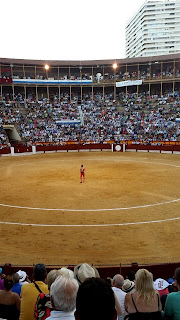
The third bull was taken on by El Fandi. He had been on the sidelines talking with the other two Matadores, and, it appeared, giving them pointers. He and his cuadrilla stepped into the arena with chants of "Fandi, Fandi" going around the crowd. All of them were dressed in a similar style, but Fandi's Traje de Luces shimmered in the sunset light. It was almost like a million camera flashes coming from every point in his jacket. 
A fanfare sounded, a door opened, and a charging black mass ran into the arena. The black bull was massive, a large hump behind the neck, and menacing horns that you definitely wanted to stay away from. El Fandi got on his knees with his purple and yellow cape, and, in one move and while still kneeling, brought the cape over the bulls head, over his own, and down to the dirt. The crowd went wild. He then continued in a more orthodox style, making the bull dance for him and waving the cape in amazing geometric patterns. The men on horseback came out, lanced the bull behind the head, and, with a second fanfare, the first period was over. 

The second period of a bullfight is called Tercio de Banderillas, in which flags on barbed hooks are driven into the bull's back. This is usually done by Banderilleros, who assist the Torero in this duty, but El Fandi walked out himself, one flag in each hand. He then told his assistants with capes to stand back, and he was suddenly one-on-one with the bull. As the bull charged, he placed both flags perfectly on each side of his spine.
 He then went to the sideline and grabbed four, two in each hand. Murmurs could be heard from the crowd, uncertain of what he was going to do. As the bull charged a second time, El Fandi strafed sideways and with a steep arch, drove both flags in his right hand into the bull's large hump. As the bull turned, annoyed, and came at him a third time; El Fandi was ready, one flag in each hand. As he drove the final two flags into the gored back of the bull, the crowd exploded in cheers and applause. A now bare-handed torero was being chased around the ring by an angry thousand-pound bull. El Fandi put a hand forward, around the bull's forhead, and, as he ran backwards, managed to coerce the bull into stopping his charge. A final fanfare announced the start of the third period.

At this point I had understood that this show wasn't about making an animal suffer for amusement, or just a way to provide the town with around 6,000 pounds of beef in one sitting (which it is), but rather a celebration of bravery. Proving to everyone in attendance that you have complete control of a bull to the point to where you can make a killing machine dance with you, and doing it nonchalantly to make it seem easy. Proving you've got the biggest cojones in the entire arena (including the bull's), and that no one would even try to do what you're doing. Looking danger literally in the face and laughing. Maybe if I would have been born in Sevilla I would have wanted to be a torero, and maybe in an alternate universe I am one, because honestly it sounds like something I'd like to do.  

El Fandi picked up his red cape and his sword and, as the in-house band started playing traditional Spanish music, prepared for the final dance. 


The final round was the mano-a-mano and the fitting and honorable end of the fight. The bull charged time and time again at the Torero's request, and after three or four charges, El Fandi would turn his back on the bull to salute the crowd and celebrate as the entire arena yelled Ole.
 As the fight wore on, the crowd began to take out their white handkerchiefs to salute the Matador. 


The biggest surprise of the event came as El Fandi was coming towards the end of the fight. The arena began yelling "Indulto! Indulto!", which in Spanish means Pardon. If a bull performs exceptionally well in the ring, the crowd may decide to spare his life; which was what was happening now. The entire arena was pleading to the Presidente (who presides over the arena and serves a the main judge) to pardon the bull, let it get treated by a vet and get released back to his free-range ranch to become a breeding bull. It was a scene straight out of a Roman gladiator arena, and I could even imagine (I couldn't see the President myself) the President sticking his thumb out to decide the bull's fate. 

El Fandi was standing over the bull, red cape in his left hand lowered to keep the bull's interest, and in his right hand, his sword, menacingly pointed at the bull. He was looking up for a decision from the Presidential balcony. I saw him register the order with a sigh and a look of disappointment. He turned his attention to the bull. The entire arena grew silent. 

With one sleek, coherent movement, El Fandi lowered the cape and began thrusting the sword towards the bull. With one final charge, the bull dipped his head to reach down towards the red cape, exposing his weakened neck. The sword began burrowing into the bull's flesh, driven by both the Matador's strength and the bull's charge, until the entire blade had impaled the bull and only the hilt of the sword stuck out from the bull's back. El Fandi, at this point, had jumped to dodge the final cornada, and was out of harm's way as the bull's heart bled out and the bull began to lose its footing. 

The arena was a mixture of somber applause for the bull and Torero, and vulgar insults directed at the President. As the bull hit the dirt, he was quickly granted the coup de grace with a dagger by one of the assistants. Two large workhorses came in, and the bull was granted a lap of honor around the arena as the entire crowd paid their respects. Half-way through the lap the horses stopped, and El Fandi came over to kiss the bull, pat it a couple of times and give it a half hug. It was then hauled off to insides of the arena. 

A short time afterwards, a man dressed in what I can only describe as Medieval minstrel chic gave El Fandi two large tufts of fur; the bull's ears. The entire crowd cheered as El Fandi held the trophies up (proof of an excellent fight) and eventually parted with them by throwing them into the crowd (after he threw the first one, I half expected a t-shirt cannon to be brought out and used for launching bull ears into the upper sections of the arena).

There were three more fights after this one, and they were alright, but it was nothing compared to the third fight. As we walked out after the third one, we got the rare chance to see the final bull get hauled off the arena and up to the slaughterhouse, where he would be cut down to his tasty component parts. He was hung by one of his hind legs, and a guy with a belt of knives started working in a process I have become quite familiar with. As I was walking out, through the large trail of blood left by the animal, I got some on me. That had me thinking about the symbolism of almost literally having blood on my hands, and it honestly didn't worry me that much.